Introduction
The practice of suttee (sati)—where a widow self-immolates on her husband’s funeral pyre is commonly considered a Hindu tradition, particularly among Rajputs and high-caste Hindus. However, historical records indicate that widow-burning and self-sacrificial immolation were practised in other cultures, particularly among steppe nomadic and Central Asian warrior societies.
One of India’s earliest recorded cases of suttee appears in the Eran inscription (510 CE), which describes a widow immolating herself upon her husband’s death. This coincides with another Eran (M.P.) inscription mentioning the Hunnic ruler Toramana, raising questions about a possible Hunnic connection to the suttee. Additionally, the self-immolation of Hindu Shahi King Jayapala and the martial valour of the Hunnic King Mihirakula further suggest that self-sacrifice as an act of honour was not limited to Hindu traditions but had deep ties to steppe warrior cultures.
This blog explores the Hunnic influence on suttee and warrior self-sacrifice, arguing that widow immolation and self-immolation were cultural phenomena reinforced by the Central Asian warrior ethos, later solidified in Rajput traditions.
Hunnic and Central Asian Influence on Suttee
The Huns, particularly the White Huns, migrated into India during the 5th–6th centuries CE, bringing warrior traditions that emphasised ritual death and funeral sacrifice. The practice of widow immolation and mass suicide to avoid capture or dishonour was common among steppe nomadic cultures, including the Scythians, Sarmatians, and later Mongols (Herodotus, The Histories).
Hunnic Funerary Practices and Widow Sacrifice
- The Huns, along with their Central Asian predecessors, practised widow sacrifice, where wives and concubines of deceased warriors were burned or buried alive to accompany their husbands in the afterlife (Chinese Annals of the Northern Wei).
- The Xiongnu, an early confederation of steppe nomads often linked with the Huns, had similar customs, where the wives of rulers and warriors were often sacrificed or forced to commit suicide (Bichurin, Collection of Materials on the History of Central Asia).
- Among the White Huns, burial sites reveal multiple bodies, often those of warriors buried with women, indicating ritualistic sacrifice as a funerary rite (Vincent Smith, Oxford History of India).
- The Rajputs, believed to have partially descended from Scythian and Central Asian groups, continued similar self-sacrificial practices, particularly Jauhar (mass self-immolation) in the medieval period.
Hunnic Influence on Indian Warrior Ethics
- The Hunnic warriors held extreme views on honour and death, preferring self-sacrifice over surrender. This warrior ethos closely aligns with suttee and Jauhar traditions among Indian Kshatriyas, particularly in Rajasthan.
- Mihirakula, the most infamous Alkhan Hun ruler, was known for his ruthless military campaigns, reinforcing the steppe warrior ideal that death in battle was superior to subjugation (Kalhana, Rajatarangini).
- The Eran inscription (510 CE), which records one of the first instances of sati in India, exists in the same period and region as the Alchon Hun invasions, raising the possibility that suttee was influenced or reinforced by steppe customs.
These examples suggest that the Hunnic tradition of widow sacrifice and warrior self-sacrifice blended with Indian warrior practices, particularly among Rajputs and Kshatriyas.
Paliya Stones in Saurashtra and Kachchh
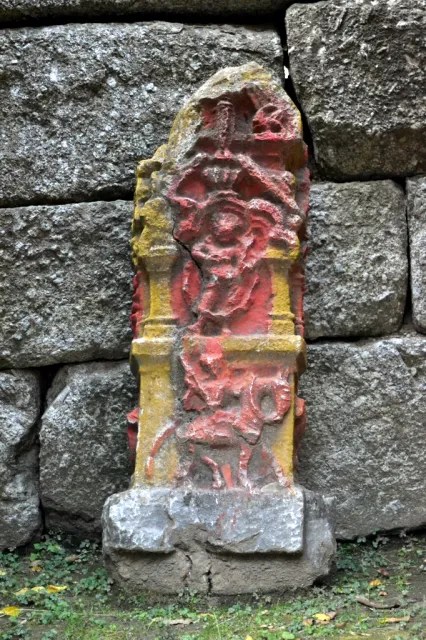
- In Saurashtra and Kachchh, memorial stones known as Paliya were erected to honor those who died in battle or performed acts of self-sacrifice (Tilok Thakuria, Memorial Stones from Gujarat: Study of Paliyas at Kanmer).
- The inscriptions on these stones often depict heroic figures, such as warriors on horseback or widows who committed sati.
- These stones are closely linked to similar practices found in Central Asia, where nomadic cultures erected steles and grave markers for fallen warriors and their widows.
- Kanmer and other sites in Gujarat contain sati stones that resemble those found in regions once controlled by Hunnic and Scythian groups, suggesting a cultural continuity between steppe traditions and Rajput memorialization.
Sati Stones in Rajasthan and Rajputana
- Sati memorials in Rajasthan, particularly in Bikaner, show an architectural and artistic style distinct from purely Hindu traditions, incorporating motifs and inscriptions resembling steppe warrior symbols (Hermann Goetz, Art and Architecture of Bikaner State【154†source】).
- The Paliya stones of Gujarat and Rajasthan often depict heroic warriors wielding weapons, a tradition that echoes Hunnic funerary stele found in Central Asia.
- These stones are ritualistic markers of honor and sacrifice, reinforcing the warrior ethos that persisted in Rajput culture and may have been influenced by earlier Hunnic customs.
Suttee in the Indian Context
Although suttee became deeply entrenched in Indian society, Hindu scriptures did not mandate it as a compulsory practice. The Rigveda (10.18.7) suggests that widows should return to life instead of joining their deceased husbands in death (Rigveda, trans. Ralph T.H. Griffith, 1896). Similarly, the Atharvaveda encourages widow remarriage. The Manusmriti (Laws of Manu) prescribes a life of asceticism for widows but does not mandate immolation (Manusmriti, trans. G. Bühler, 1886).
Two alternative practices to suttee existed in Hindu tradition:
- Sahagamana: Where a widow voluntarily joined her husband in death, but it was not compulsory.
- Anumarana: A widow performed self-immolation after a period of mourning rather than immediately after her husband’s death (Garuda Purana, trans. Ernest Wood & S. V. Subrahmanyam, 1911).
During the Gupta period (4th–6th centuries CE), inscriptions indicate that suttee became more common among Kshatriya warrior elites, possibly as an honour-bound practice rather than a religious obligation. The Skanda Purana and Brahma Purana described suttee as a personal choice rather than an enforced duty, indicating a gradual ritualisation influenced by warrior ethics.
Conclusion
The practice of suttee (sati) in India is often viewed as an exclusively Hindu tradition, but historical evidence suggests a broader and more complex origin. The Hunnic invasions of India during the 5th–6th centuries CE coincided with the earliest recorded inscriptions of widow immolation, raising the possibility that suttee was influenced or reinforced by steppe warrior customs. The Hunnic, Scythian, and Central Asian traditions of widow sacrifice and warrior self-immolation likely merged with existing Kshatriya ideals of honour, contributing to the institutionalisation of suttee among Rajput elites.
Furthermore, British colonial narratives misrepresented the prevalence of suttee, inflating statistics to support their mission of social reform and justify imperial control. The practice was already in decline due to internal Hindu-led reform movements, but British reports emphasised its occurrence by presenting Hindu traditions as needing Western intervention.
Ultimately, suttee is best understood as a cultural phenomenon shaped by multiple influences, including Indo-Aryan, Hunnic, and Rajput warrior traditions, rather than as an exclusively Hindu or religious practice. By examining the broader Eurasian connections and colonial distortions, a more nuanced historical understanding of suttee emerges—one that reflects both its complex origins and its political reinterpretations over time.
Bibliography
- Herodotus, The Histories.
- Chinese Annals of the Northern Wei, translated accounts of Hunnic funerary rites.
- Bichurin, N. Y., Collection of Materials on the History of Central Asia.
- Vincent Smith, Oxford History of India.
- Kalhana, Rajatarangini.
- Chakrabarty, Dipesh, Colonialism, Modernity, and the Sati Debate, Oxford University Press, 1998.
- American Board of Commissioners for Foreign Missions (ABCFM), Report on Suttee in Bengal Presidency, 1829.
- Bentinck, Lord William, Government Report on Suttee in India, 1829.
- Peggs, James, India’s Cries to British Humanity, London, 1832.
- Yang, Anand A., The Limited Raj: Sati and Female Agency in Colonial India, Journal of Asian Studies, 2003.

Leave a comment