An independent synthesis of Mughal administrative records, colonial gazetteers and ethnography, bardic tradition, and molecular data
Abstract
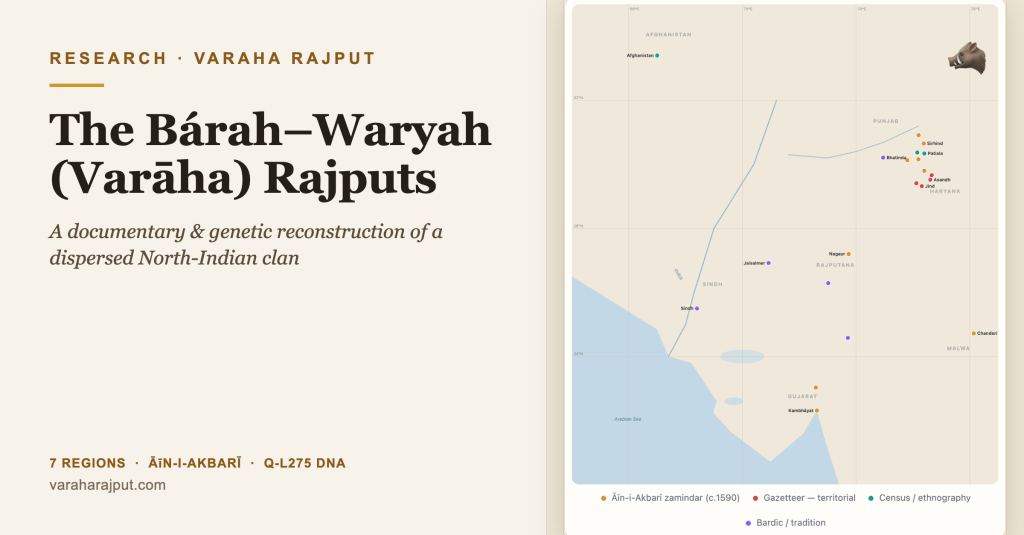
This paper reconstructs the history and distribution of a North-Indian Rajput clan recorded under the closely related names Varāha, Bárah, Baráh, Baria, Warah, and Waryah. Drawing on the Āīn-i-Akbarī (c. 1590), the district gazetteers and censuses of colonial India (1881–1938), Rajput bardic and princely-state traditions (Tod, Nainsi, the Rajputana Agency lists), and a molecular ancestry analysis of a present-day clansman, it argues three points. First, the clan is documented across seven regions of northern and western India and the frontier — the Sirhind–Samana Punjab, the Karnal–Jind tract of Haryana, Rajputana (Nagor, Marwar, Jaisalmer, Mewar), Gujarat (Cambay, Ahmadabad), Malwa (Chanderi), Sindh, and (per Bellew) Afghanistan — a footprint unusually wide for a non-ruling agrarian clan, and in Haryana rising to an attested statement of territorial control. Second, this distribution establishes a substantial and long-established presence, and locally a territorial hold, though not — on the surviving evidence — a documented sovereign dynasty. Third, the clan’s origins, long attached in family tradition to the Central-Asian “Hunnic” (Hephthalite/Alkhan) world through the boar (varāha) emblem, remain a plausible but unproven hypothesis, to which molecular data lend a suggestive, corroborative, but non-determinative signal. The paper is offered as a template for how a clan poorly served by the record of 1100–1400 CE can be reconstructed from convergent later evidence. The attested localities are mapped in Figure 1.
A note on sources. This synthesis cites primary and secondary scholarship directly and does not rely on any prior monograph by a member of the clan, in order to keep the argument independently verifiable. The genetic sample is that of a single living clansman (n = 1).
1. Introduction
The historiography of the Indian subcontinent between roughly 1100 and 1400 CE is uneven. The Ghurid conquest, the Delhi Sultanate (1206), and the Khalji and Tughlaq regimes are recorded in a rich Persian chronicle tradition — Minhāj-i-Sirāj, Ziyā’ al-Dīn Baranī, Amīr Khusraw, and ʿIsāmī. But that tradition records the conquerors and their campaigns; it is comparatively silent on the internal social organisation of the indigenous, non-ruling Rajput and agrarian clans over whom the Sultanate’s authority passed. Clans on the losing side of the conquest, or absorbed into the new order as subordinate landholders, frequently drop below the horizon of the written record for two or three centuries, re-emerging only in the Mughal cadastral surveys of the sixteenth century and the colonial ethnographies of the nineteenth.
The clan examined here — recorded under the interchangeable names Varāha / Bárah / Baráh / Baria / Warah / Waryah — is a case in point. It is nowhere the subject of a Sultanate-era chronicle, yet when the documentary curtain lifts in 1590 it appears not as a marginal remnant but as a landholding caste distributed across widely separated regions.
A note on nomenclature. The forms Varāha, Bárah, Baráh, Baria, Warah, and Waryah are treated here as transliteration variants of a single clan-name, from the Sanskrit varāha (“boar”). Two cautions apply throughout. First, the spelling Barah can also render the unrelated word bārah (“twelve”), which underlies many place-names; occurrences are therefore admitted only in caste or clan context. Second, the clan should not be conflated with the larger, separately documented Waraich / Warraich Jat clan of Gujrat, nor with the Barha Sayyids of the Muzaffarnagar bārha tract (Kolff, Naukar, Rajput and Sepoy) — both homophones of different origin.
2. Mughal Administrative Evidence: The Āīn-i-Akbarī
The single most important body of documentary evidence is Abū’l-Faẓl’s Āīn-i-Akbarī (c. 1590), the administrative gazetteer of Akbar’s empire, in the translation of H. S. Jarrett (Vol. II). For each maḥal (revenue sub-district) it records the assessed bighas, the revenue demand, the suyūrghāl, and — critically — the caste of the zamindars together with the cavalry and infantry they were bound to furnish. The zamindar-caste column is thus a near-census of the dominant landholding lineage of each locality. The clan-name Bárah appears in it across several subahs.
Subah Gujarat (Jarrett II, p. 253). For the port-city of Kambhāyat (Cambay) the zamindar castes are given as “Rájpút, Bárah,” the maḥal assessed at 336,813 bighas and a levy of 100 cavalry and 200 infantry. The neighbouring Bárah Sewah appears in the Ahmadabad sarkar.
Subah Delhi, Sarkar Sirhind (Jarrett II, p. 296). Across the Puadh–Malwa tract on the Punjab–Haryana border the Āīn records Baráh as a zamindar caste in contiguous maḥals: Sirhind (“Rájpút, Baráh, Khauri, Dádah, Jat”); Samánah (“Baráh, Jat, Ranghar…”; 904,261 bighas, 700 cavalry, 2,000 infantry); Sunám (“has a brick fort”); Kethal (“has a brick fort; here Hindu shrines” — “Rájpút, Ranghar, Jat, Baráh (var. Bárah)”); and Máchhiwárah (“has a brick fort”).
Subah Ajmer and Subah Malwa (index, p. 12). The index records “Bárah-gáin” in Sarkar Nagor (Ajmer), and “Sánólad Bárah” near Chandéri (Malwa).
What this establishes. The exact pairing “Rájpút, Bárah” recurs in both Cambay (Gujarat) and Sirhind (Punjab) — localities some 800 km apart — stronger evidence of a single, dispersed clan than isolated homophones would be. The Bárah zamindars are consistently attached to forts and troop levies, marking an armed, fort-holding landholding class of local standing. The Āīn‘s framework is, however, one of zamindars under Mughal sovereignty: the evidence documents a wide landholding presence and local military standing, not independent rule, and it postdates 1100–1400 by two to four centuries. The identification of the Sirhind and Bet Jālandhar Doab maḥals with the clan, and the wider argument for its dispersal across the northwest, is developed by G. S. L. Devra, both in his NMML study Environmental Crisis and Social Dismemberment in Northwest India during the Pre-Colonial Period and in Devra & Arora (2012).
3. Colonial Gazetteers, Ethnography, and Census
The Mughal record is continued by the systematic documentation of British India — and here, in Haryana, the evidence rises from landholding to territorial holding.
District gazetteers (Haryana). The Karnal District Gazetteer (1892, p. 106) — repeated in the Hissar District Gazetteer (1915, p. 106) — states plainly:
“Barah Rajputs held the country round Asandh, Safidon, and Salwan; while the Pandirs held Thanesar and the Nardak…”
This is the strongest single statement in the corpus: not merely that Bárah zamindars were assessed for revenue, but that Bárah Rajputs held the country — exercised territorial control — over a defined Karnal–Jind tract, set beside the neighbouring Pandirs. The Journal of Haryana Studies (Vol. 3, p. 9) further associates the Bárah with the Jind tract and its Mahābhārata/Vāmana-purāṇa tīrtha sites.
Punjab ethnography and census. Denzil Ibbetson‘s Report on the Census of the Panjab, 1881 (1883) records “a Waria Rajput” in the Gil origin-legend — his Gill pedigree (Pedigree I, p. 300) naming the ancestor Pirthipal, Raja of Garh Mathila, “a Waria Rajput,” in a descent-line that itself includes a Vinepal / Vinaypal (recompiled in Gurcharan Singh Gill, Deeper Roots of the Gill, Bhatti, Sidhu, Brar, Toor and Related Jat and Rajput Clans, Indian Family History Society, 2008, p. 12). H. A. Rose, A Glossary of the Tribes and Castes of the Punjab and NWFP (1911, Vol. II, pp. 63–64), gives the fullest colonial account: the Baria, a Rajput tribe of Patiala and Nabha, descended from an eponym Warah whose grandson Raja Banni Pal is credited in tradition with founding Bhatinda. Rose’s Patiala-State entry, headed “Barah or Varah Rájpúts” (explicitly pairing the two spellings), adds that they “claim descent from Binepál of Bhatinda and emigrated … from Udaipur,” preserve the clan proverb “the lion, the hawk and the Varáhs never taste stale meat,” and converted to Islam only recently — Rái Kálu of Kákrá embracing Islam under Jahāngīr, while “the Baráhs of Bakhtrí … are still Hindus.” The Phulkian States Gazetteer (1904) documents the clan’s formalised structure of twelve chhats and twenty-four makans across Patiala, Nabha, Jind, and British territory. The Census of India, 1901 (Punjab) enumerated 22,453 Baria Rajputs — 21,986 Muslim — concentrated in Patiala (11,474) and Nabha (4,531).
The name recurs across the wider ethnographic corpus: R. V. Russell, The Tribes and Castes of the Central Provinces of India (1916); A. H. Bingley, Sikhs (1899); H. H. Risley, Tribes and Castes of Bengal (1892); Sir H. M. Elliot, Memoirs on the… Races of the North-Western Provinces (1869); and the proverb and dictionary literature (Maconachie 1890; Fallon 1886). Beyond the subcontinent, H. W. Bellew, An Inquiry into the Ethnography of Afghanistan (1891), lists Waria among the tribes of Afghanistan — extending the attested footprint to the north-western frontier and coinciding with the Central-Asian corridor addressed in §5. M. A. Sherring, Hindu Tribes and Castes (Vol. III, 1881, p. 88), lists “Baraha — a tribe of Rajpoot converts to Islam in the Rajputana desert,” placing the clan among the Muslim-convert Rajput tribes of the desert — an independent echo of Tod’s “largely converted to Islam” and of the census’s overwhelmingly-Muslim Baria. Cassell’s Storehouse of General Information (Vol. I, 1891, p. 173) reaches further west still, identifying the Brahui of Baluchistan as “the Baraha of the early Rajput records” (citing Pottinger 1816 and Walters 1874). This is a genuine nineteenth-century attestation of the Baraha name in Rajput tradition, but the specific Brahui-identification is speculative colonial ethnology — the same entry describes the Brahui as Dravidian-affinity highland aborigines who claim to be Baluchistan’s original inhabitants, a profile that corroborates the currency of the name rather than the Central-Asian origin argued in §5, with which it is in tension — indeed the Brahui, a long-established Dravidian-affinity people whom Cassell itself calls Baluchistan’s original inhabitants, would on any reckoning predate the fifth–sixth-century Alkhan/Hun horizon that the Waria tradition invokes, so the equation runs against the chronology and can attest only the name, not descent. R. G. Latham, Ethnology of India (1859), supplies a further nineteenth-century notice, observing that “in Ferishta, and doubtless in other historians of India,” there are “numerous notices of a hostile nation called Varahas,” whose attacks fell on “the western States of Rajasthan” — an independent literary echo of the desert-frontier presence Tod documents (§4). Edward Balfour‘s Cyclopaedia of India (3rd ed., 1885, p. 919) independently lists “the Baraha and Lohana tribes” among the desert peoples of Sindh and the Thar, ranked among the “36 royal races of ancient India” — in the same passage in which the neighbouring Johya and Dahya are traced to the “Gete, Jut, or Hun.” This places the Baraha, by name, within the Scytho-Hunnic desert milieu of §§4–5, though Balfour does not himself assign the Baraha a Hunnic descent.
4. Bardic, Genealogical, and Princely-State Tradition
Several traditions carry the clan’s memory back toward, and beyond, the 1100–1400 window — with the reduced evidentiary weight proper to genealogical literature.
James Tod, Annals and Antiquities of Rajasthan (Annals of Jaisalmer, Vol. II, p. 204 n. 5) identifies the Barahas as an Indo-Scythic tribe — glossing the name as “the hogs” — who held the territory around Vitheda / Bhatinda before the arrival of the Bhatis, and who by his day had largely converted to Islam. Tod’s Annals of Jaisalmer document the Barahas at length — a desert tribe locked in a centuries-long feud with the intruding Yadu-Bhatis from the eighth century (the Bhati fort of Tunnote completed in S. 787 / A.D. 731), a feud punctuated by intermarriage and by the treacherous wedding-massacre of the Bhatti Beeji Rae, and a Baraha bhomia of 1,500 horse still holding land near Nagore in the later annals. Tod states outright that “the name of Baraha, as an ancient Indo-Scythic tribe, is … abundantly preserved in the annals of Jessulmeer,” and even connects the Barahas to Pottinger’s Baluchistan (cf. the Brahui note in §3). As the Bhati foundation of Jaisalmer is dated c. 1156 CE, Tod’s tradition places the Barahas as a territorial power in the strategically vital Bhatinda region at or before the opening of the twelfth century — a horizon consistent with the Archaeological Survey of India’s dating of the fort’s core fabric to the eighth–ninth centuries. Rima Hooja, A History of Rajasthan (2006, p. 246), likewise sets the Varah Rajputs within the Bhati consolidation of western Rajasthan. The episode recurs in recent scholarship: David Gordon White, The Alchemical Body (1996, pp. 122, 309–10), and the edited volume The Power of the Nāth Yogis (2025) record that in the ninth century Deorāj, prince of the Rāwal house of Jaisalmer, survived the massacre of his family “at the hands of the Baraha” and re-established the line under the protection of a Nāth yogi. Here a distinction matters: the 2025 volume files the tale under the legendary history of yogic charisma, and the Nāth wrapper — the yogi Rita, the alchemical rasa kumbha — is frankly legend; but the underlying datum, a dominant Baraha power that the nascent Bhati–Rāwal dynasty had to overcome to seat itself at Jaisalmer, is treated as historical in Tod and the Jaisalmer annals themselves, and it corroborates the clan’s territorial standing in the desert before the Bhati consolidation.
The fullest modern reconstruction is G. S. L. Devra’s, who has devoted a dedicated study to the clan — “Varhas: A Forgotten Clan of North-West India (Pre-Medieval Period)” (PIHC 2003) — and returns to them in his NMML Dismemberment paper. Reading the Āīn, Rose, and the Bhati chronicles together, Devra locates the Varhas’ seat at Vitheda (identified with modern Bhatinda) and reconstructs a protracted Varha–Bhati rivalry: in the tenth century the Varhas, allied with the Panwars/Parmars of western Rajasthan, expelled the Bhatis from the forts of Bhatner and Tanot; the Bhatis’ later revenge broke Varha power and forced many families into other castes and occupations. In this account the Varhas survived as a political entity until the establishment of the Delhi Sultanate, declining in central and lower Punjab after Prithvīrāja Chauhan’s defeat and thereafter persisting at the village level under the iqtā/pargana administration — the very condition in which the Āīn finds them c. 1590. Offshoots, Devra notes, migrated to Sind and Gujarat, where family tradition makes them ancestral to the Makwanas / Jhalas, while others merged into the Gill Jats; a pastoral stratum (the “Gopālas”) and a local water-deity cult (Khwāja Khiḍr, via one Ratananth “of the family of Varhas”) attach to the same tradition. Much of this rests on Bhati bardic record and is best read as a reconstruction rather than documented fact, but it is the most sustained scholarly treatment the clan has received.
A parallel reconstruction survives in Punjabi-language historiography. Visakha Singh‘s Mālwā Itihās records a Varāha dynasty seated at Bhatinda under Rāja Vinaypāl, extending its reach from Bhatinda toward Lahore, and dates the dynasty’s fall to the early eleventh century (c. 1010 CE) amid Mahmūd of Ghazna’s campaigns — associating the clan’s Vinaypāl with the Hindu-Śāhi world of Jayapāla and Ānandapāla. This is the same maximal reading as Devra’s, and carries the same caveat: a twentieth-century vernacular history resting on bardic and traditional material, cited here as corroborating the Bhatinda–Vinaypāl tradition (§3–§4), not as independent proof of a sovereign Varāha kingdom.
A Sindh tradition. The List of Ruling Princes, Chiefs and Leading Personages (Rajputana Agency, 1938, p. 59), and the Memoranda on the Indian States (1939, p. 300), preserve a genealogical claim that Varah, a descendant of Vikrama, “kept for himself the province of Sindh” when dividing his territory among his brothers — a tradition still current in Rajputana in the twentieth century.
Marwar. The Census of Marwar (1891), and the Census of India, 1961: Rajasthan (p. 9) reporting it, list Varah among the Rajput clans enumerated after Muhṇot Nainsī’s Khyāt.
A western branch is adduced for the Cholistan desert-forts (Uchchha, Derawar), attested through Nainsī and the history of Bahawalpur, and displaced only with the founding of the Bahawalpur state in 1748. Tod’s Annals of Jaisalmer place the Barahas among the ruling desert lineages before the Bhati consolidation — beside the Lodras of Lodorva, the Sodas of Dhat, and the Paramaras of Pugal — the Bhati chief Mungal Rao settling “in the centre of the lands of the Lodras, the Barahas, and the Sodas,” and a later marriage to a woman “of Baraha tribe” producing the Cheda Rajputs (Pal ed. 1905, pp. 1063–64; recompiled in Gill 2008, pp. 23–24).
These traditions are semi-legendary: they preserve clan memory rather than contemporary record, and the “held Bhatinda before the Bhatis” and “Vikrama… Sindh” motifs function partly as charters of antiquity. They are cited here as tradition consistent with an early and significant presence, not as documentary proof of it.
5. The Question of Origins: The Hun / Hephthalite Hypothesis
Family tradition and the boar-name have long attached the clan to the Central-Asian “Hunnic” world — the Hephthalites, the Alkhan of Gandhāra (Rahman 1979; Stein 1973; Verdon 2021), and the Sasanian noble House of Wārāz, whose name is a securely attested Iranian personal name meaning “boar” (Sims-Williams, Bactrian Personal Names). The varāha (boar) is a genuinely shared emblem: the third avatāra of Viṣṇu and the subject of Toramāṇa’s Eran boar inscription (c. 510 CE); the Sasanian symbol of the war-god Wahrām/Verethragna; and a recurring motif in steppe animal-style art (Cunningham 1894; Kingsmill). The Sasanian association is visual as well as onomastic: the Freer (Stroganov) plate of Shāpūr II — the sole Sasanian royal hunting plate to depict a boar — has been read by Prudence O. Harper as emblematic of the king’s eastern campaigns, in the same milieu in which Wārāz (“boar”) named a powerful eastern-Iranian noble house (Harper, in Gunter & Jett, Ancient Iranian Metalwork, 1992). Regional rulers bearing the Varāha name — Dharaṇivarāha (a Chāpa feudatory), Jayavarāha (Saurashtra), the Aulikaras of Mandasor (Salomon 1989), the Sanjeli-plates milieu of Toramāṇa’s Gujarat (Ray 2003), and the “Ādi-Varāha” title of the Gurjara-Pratīhāra Mihira Bhoja (whose epithet the Arab travellers rendered Bauūra, “a corruption of Varāha or Barāha” — Munshi, in Majumdar, ed., The Age of Imperial Kanauj, HCIP IV, p. x, an authoritative pairing of the two spellings) — show the currency of the boar as a royal emblem across western India. The same royal title may recur in the Arab geographers: H. C. Ray (“The Word Ba’ruah in the Murūj al-Dhahab of al-Masʿūdī,” Indian Historical Quarterly XVIII, 1942), following Ferrand’s and Marquart’s reading Bārūza / Bareza, takes al-Masʿūdī’s title for the king of Kannauj-and-Sindh as a Persian rendering of Varāha — a second, independent onomastic bridge between the boar-name and the Pratīhāra imperial style, though the phonetic reconstruction remains contested. The Chapa-Gurjara connection is itself contested numismatically: V. A. Smith’s “White Hun” coin of Vyāghramukha of Bhinmal must be dated to the early seventh century (Vyāghramukha being Brahmagupta’s patron, c. 628 CE), correcting a common century-early attribution. A recent Y-DNA genealogical study pushes this emblem-thread further, proposing the Varāha (wild-boar) “totem tribes” as precursors of the Chalukyas and Gurjara-Pratīhāras and as kin of the Parthian–Hephthalite House of Wārāz, with the Saurashtra Garulakas bearing the title Varāhadāsa (“devotee of the Boar”); it is noted here only as a parallel — its argument is speculative and its provenance unconfirmed, and by caution 1 (below) a shared boar-emblem is not evidence of shared descent.
On the Central-Asian corridor itself, the authoritative reconstruction is Abdur Rahman’s (ANU thesis 1976; publ. 1979). Three of his findings bear directly on the clan’s tradition. First, he shows that the cave-emergence founder Barha Tegin (Barhatigin) is the Turk Śāhi founder of c. 666 CE — not the sixth-century Alkhan Toramāṇa, with whom he is sometimes conflated; and the Hindu Śāhi Toramāṇa/Kamalū (early tenth century) is a distinct figure again. Second — and to the tradition’s advantage — Rahman derives the Turk Śāhis from the Khalaj, whom, following Frye, Sayili and al-Khwārazmī (“the Turks called Khalaj… are [the Ephthalites’] remnants”), he regards as remnants of the Ephthalites (White Huns): on this reconstruction the Śāhi dynasty’s deep origin is genuinely Hunnic — precisely the milieu the clan’s own tradition invokes. Third, on the vexed question of caste, Rahman leans against al-Bīrūnī’s report that the founder Kallar was a Brahman and toward Kṣatriya status for the line, citing Mas’ūdī’s description of Gandhāra as “the country of the Rahbūt (Rajpūt),” Kalhaṇa’s record of the Śāhi Bhīma’s matrimonial ties to the Kṣatriya rulers of Kashmir, and the -varman suffix of Bhīma’s father Kamalavarman. He does, however, assign the Hindu Śāhis specifically to the Gakhars (a Salt-Range tribe he links, after Cunningham, to the Kidāra Kushans) — so the identification of the dynasty with the Varāha clan remains Devra’s interpretation, not Rahman’s. The boar-emblem “Śāhi” world to which the clan’s tradition appeals is thus not only real and well-documented but, in Rahman’s own reconstruction, of Ephthalite (Hunnic) descent and probably Kṣatriya standing; what remains unproven is the specific equation of that dynasty with this clan.
Against this backdrop, G. S. L. Devra advances the clan’s boldest historical claim in scholarly form. In his NMML study he holds that the Varhas “ruled over the frontier parts of the country (including Kabul)” in the eighth–ninth centuries, “their rulers with the title of Tegin” being “known as Turki Shahis,” and that only “after the capture of their power by their ministers (Hindu Shahis)” did they retreat to settle around Bhatinda and Talwandi — the very heartland the Āīn later attests. This is the scholarly form of the clan’s own tradition equating Barha Tegin with Varāha (boar + the Turkic title tegin, “prince”), and it would tie the clan directly to the Śāhi throne. It must, however, be weighed against Rahman, for whom the Turk-Śāhi founder Barhatigin is a Khalaj Turk and the Hindu-Śāhi line is traced to the Gakhars, not to the Varhas. The Varāha–Turk-Śāhi identification is therefore best presented as a live scholarly argument (Devra), not a settled consensus — a genuine reading of the evidence that the standard reconstruction (Rahman) does not endorse, and one that the competing “shaggy-dog” (baraq) etymology of Barha Tegin further unsettles.
Three cautions govern any use of this material:
1. Shared emblem ≠ shared descent. The boar’s appearance across Iranian, Indic, and steppe cultures reflects a shared symbolic vocabulary, not a genealogical link. The Eran inscription attests the deity, consecrated by a Brahmin, not a self-identifying “Varāha clan.”
2. The onomastic chain (Varāha ≈ Wārāz ≈ Bárah ≈ “boar”) is suggestive, not probative. Equating a Sasanian noble house, the Alkhan, and a later Rajput clan on the strength of a boar-name is an inference the primary epigraphy does not itself make.
3. The “Rajput = foreign Hun” thesis is contested in modern scholarship, and should be presented as one interpretation among several; the very term Rājaputra has a debated history (Misra 1941), and the Gurjara-origin literature (Jackson, V. A. Smith, Bhandarkar) is divided on whether “Gurjara” marks descent or territory.
The origin question is therefore best held as a structured hypothesis: the clan may preserve a Central-Asian, boar-emblem heritage entering the north-west through the Hephthalite/Alkhan corridor; the epigraphic and numismatic record is consistent with such a milieu without demonstrating the specific descent.
New epigraphic evidence: three notices from Epigraphia Indica
1. “Mahā-Varāha = Barāhā, an old Rājpūt clan.” D. R. Bhandarkar’s List of the Inscriptions of Northern India (appended to Epigraphia Indica) records a hero-stone (devlī) from Baṛlū, Jodhpur, dated V.S. 1063 (A.D. 1006), commemorating Rājā Dahita, son of Javikava, styled a Mahā-Varāha — to which Bhandarkar appends the note that the term “corresponds to Barāhā, an old Rājpūt clan” (no. 102 and n.; index s.v. “Mahā-Varāha (Barāhā) = Rājpūt tribe”). A dated, independent, official ASI attestation that Varāha and Barāhā name one ruling Rajput lineage in Marwar by 1006 CE.
2. The Shāhi title is Kushano-Iranian. In the Hatun rock inscription of the Palola Ṣāhis of Gilgit (Epigraphia Indica XXX, no. 38), Sir Aurel Stein identified the styling Patōla-shāhi / Shāhānushāhi as the title “known from references to Kushāna rulers” — the ŠAONANO ŠAO (“king of kings,” Iranian šāhānušāh) of Kushan coinage in Indian dress (EI XXX: 226). The Shāhi title of the north-western dynasties thus descends directly from Kushano-Iranian royal titulature.
3. A Shāhi dynasty of boar descent — and a boar-named coin. The same record describes Patōladeva as of the Bhagadatta-vaṃśa, whose ancestor “was born of the Earth and of Vishnu in his Boar-incarnation” (EI XXX: 226) — the Varāha (boar) as dynastic progenitor, as also for the Bhauma-Naraka kings of Prāgjyotisha, “worshippers of Varāha.” The boar-title even entered the currency: the Siyaḍoṇī inscription (EI XXX: 212–13) records the Ādivarāha-dramma, a silver coin named after the biruda Ādivarāha of the Pratīhāra emperor Bhoja I (c. 836–885 CE).
6. Genetic Evidence
To complement the documentary record, the direct paternal and maternal lineages and the autosomal profile of a single living clansman were analysed. The results are corroborative and directional, not determinative, and rest on one individual (n = 1); population-level claims await comparative sampling of documented clan families.
Paternal line (Y-DNA): haplogroup Q-L275. The sample is confirmed haplogroup Q (M242 derived) and resolves to the terminal subclade Q-L275 (the western, Q1b arm of Q). Ancestral states at M207, M269, and M3 exclude the R1a/R1b lineages and the Native-American branch (Q-M3). Q-L275 is a West/Central-Asian branch, present at low frequency across Iran (~7%), Sindh (~4.8%), and Punjab (~3.5%), and distinct from the eastern, Mongolian-Xiongnu branches (Huang, Balanovsky et al. 2018). It is best read as a corridor marker of Central-Asian gene flow into the north-west, not an exclusively Hephthalite signature.
Maternal line (mtDNA): haplogroup J1b — a Near-Eastern lineage; the West-Eurasian J clades of north-western South Asia are dated to Late-Glacial dispersals (~16–13 ka) from the Fertile Crescent (Silva et al. 2017).
Autosomal composition. A supervised admixture analysis (171,531 SNPs) yields a characteristic Northwest South Asian profile: ~38% Ancestral South Indian (AASI-related), ~46% Iranian-plateau and West-Asian, ~8% Steppe, and a small Inner-Asian component of 4.4% (95% CI 3.1–5.7%) — the modest tail expected of a western-steppe/Altai source, and far below the majority-East-Asian ancestry of the Mongolian Xiongnu.
Interpretation. Both direct lineages point west — to Central Asia (paternal) and the Near East (maternal) — and the modest steppe/Inner-Asian autosomal signal is compatible with a Central-Asian thread in the clan’s ancestry; yet the genome as a whole is predominantly South Asian. The molecular data thus cohere with a north-western clan of partly Central-Asian derivation without, on a single sample, proving a specific Hephthalite ancestry.
7. Distribution, Significance, and the Documentary Gap
We may now address the historical question: what does the clan’s wide distribution imply about its significance during the poorly-documented 1100–1400 period? The attested localities are plotted in Figure 1.
The evidence supports a carefully bounded conclusion. The convergence of (i) the Āīn‘s zamindar entries across four subahs, (ii) the Karnal Gazetteer’s statement that “Barah Rajputs held the country round Asandh, Safidon, and Salwan,” (iii) the fort-holding and troop-levies attached to the clan, (iv) the census persistence of a 22,000-strong named clan, and (v) the bardic memory of holding Bhatinda before the Bhatis and Sindh in the Vikrama tradition, collectively rules out the description of an insignificant or purely local lineage. This was a substantial, established, and unusually widely dispersed clan which, in the Karnal–Jind tract, is remembered as having held the country — i.e. exercised territorial control.
Three constraints nevertheless bound the stronger inference of sovereign dynastic rule:
- The richest distribution evidence (the Āīn) is c. 1590 and landholding; the Karnal Gazetteer’s “held the country” is a retrospective statement of an earlier tribal-territorial order, not a record of a reigning Bárah dynasty with coins or land-grants.
- Presence and local control are not the same as sovereignty. A clan may hold a tract, furnish troops, and dominate several districts without constituting an independent kingdom in the sense of a documented dynasty.
- The silence of the 1100–1400 record explains why the clan’s role is largely invisible, but silence cannot be converted into positive evidence for sovereignty.
The defensible formulation is therefore this:
The Bárah–Waryah were a substantial, long-established, and unusually widely distributed Rajput clan, attested across the Punjab, Haryana, Rajputana, Gujarat, Malwa, and Sindh — and, on the frontier, in Afghanistan (Bellew) — from the Mughal period, remembered as holders of the Bhatinda tract before the twelfth century, and recorded as having held the country round Asandh, Safidon, and Salwan in Haryana. Their role in the sparsely-documented 1100–1400 period is plausibly under-recorded rather than absent; the surviving evidence establishes a significant presence, landholding footprint, and local territorial hold, but not a documented sovereign dynasty, for that era.
A genuine eastern parallel deserves notice: the Varāhas (or Mayuras) of Bonai Maṇḍala in Orissa — a ruling dynasty bearing the boar (varāha) family-name, described as originally tribal (traditionally from Chitrakūṭa) and later upgraded to Kshatriya status through Brahmanical association (Panda 1997). This follows the very tribal-to-Kshatriya trajectory sketched above. Whether the Bonai Varāhas are a branch of the same clan or an independent lineage that adopted the boar-emblem cannot be established — the recurring shared emblem ≠ shared descent caution applies — but it is a striking parallel, and, unlike the north-western clan, this eastern Varāha line held ruling status. (By contrast, the “Varāha” of the Assam material belongs to the Naraka/avatāra mythology, and “Dharaṇivarāha of Chitor” is a Chāpa ruler of Rajasthan, not Orissa.)
This is not a diminished claim. A major, dispersed clan attested across seven regions — holding tracts of country and furnishing cavalry in several of them — yet whom the record-keepers of the conquest period were largely not writing about, is a historically significant phenomenon in its own right, and one the convergent later evidence recovers with unusual clarity.
8. Conclusion
Assembled from Mughal cadastral record, colonial gazetteers and census, bardic tradition, and molecular data, the Bárah–Waryah (Varāha) Rajputs emerge as a real, coherent, and widely distributed North-Indian clan whose documented footprint by the Mughal period spanned seven regions, who held the country in the Karnal–Jind tract of Haryana, whose organised structure persisted into the colonial census, and whose deep ancestry carries a genuine, if modest, Central-Asian signal. The clan’s specific fortunes between 1100 and 1400 remain beyond the reach of the surviving record; but its scale, territorial reach, and antiquity do not. Where the sources permit only distribution and local control rather than dominion, and hypothesis rather than proof, this reconstruction has said so — and in doing so has aimed to give the clan a footing in the historical record that is both substantial and defensible.
Figure
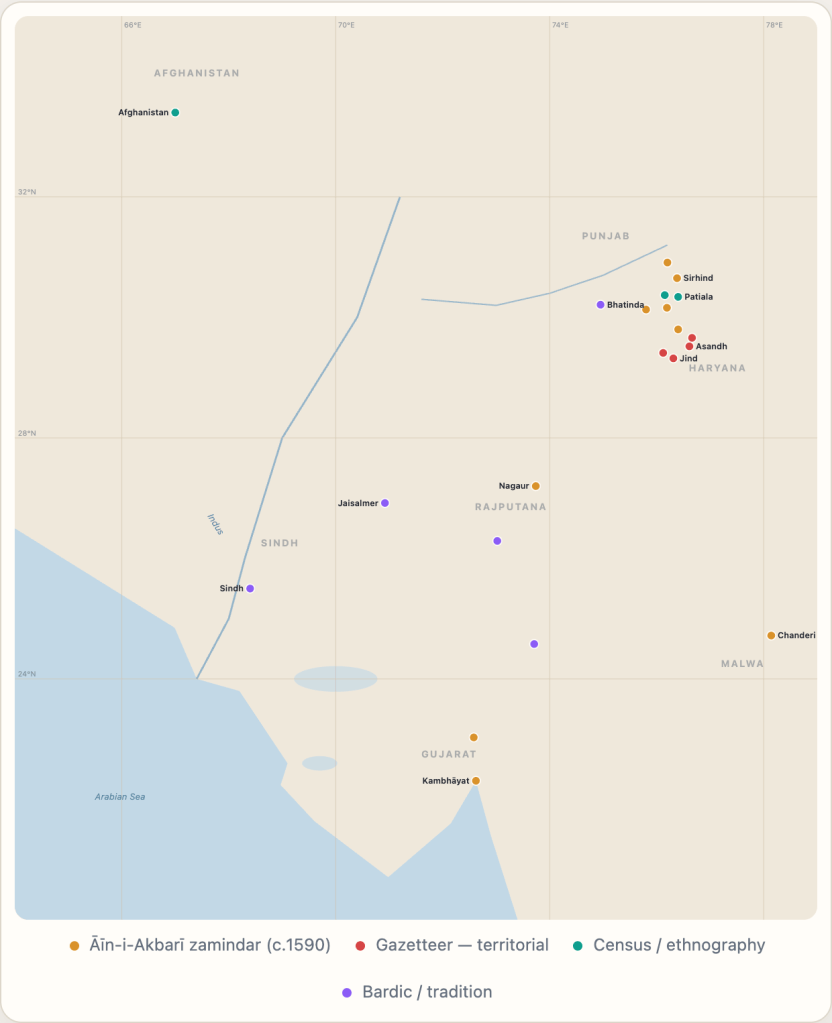
Figure 1. Attested distribution of the Bárah–Waryah (Varāha) Rajputs, c. 1590–1938. Localities across seven regions — Punjab, Haryana, Rajputana, Gujarat, Malwa, Sindh, and Afghanistan — plotted at their true coordinates on a cos-corrected projection with a latitude/longitude grid, each marked by evidence type: Āīn-i-Akbarī zamindar entry, district-gazetteer territorial account, census/ethnography, or bardic/genealogical tradition.
References
Primary — Mughal administrative
- Abū’l-Faẓl ʿAllāmī. The Āīn-i-Akbarī, Vol. II. Trans. H. S. Jarrett. Calcutta: Asiatic Society of Bengal, 1891. [Kambhāyat/Cambay: p. 253; Sarkar Sirhind: p. 296; Nagor/Chanderi: index p. 12.]
- Devra, G. S. L. “Political Wilderness and Social Dismemberment — Varhas: A Forgotten Clan of North-West India (Pre-Medieval Period).” Proceedings of the Indian History Congress, Section A, 2003. [The dedicated study of the clan.]
- Devra, G. S. L. Environmental Crisis and Social Dismemberment in Northwest India during the Pre-Colonial Period. NMML Occasional Paper, History and Society, New Series 3. New Delhi: Nehru Memorial Museum & Library. [Reconstruction of the clan’s history and dispersal; the Varha–Turk Śāhi identification.]
- Devra, G. S. L., & Arora, S. (2012). “Hindu Commanders in the Army of Sultans of Ghazna: A Case Study of Vijaypal of Bayana.” Proceedings of the Indian History Congress 73: 205–211. JSTOR 44156207. [Āīn maḥal-list identifications, fn. 76.]
District gazetteers and census
- Karnal District Gazetteer, 1892 [p. 106]; Hissar District Gazetteer, 1915 [p. 106].
- Phulkian States Gazetteer (Patiala, Jind, Nabha), 1904.
- Journal of Haryana Studies, Vol. 3 [p. 9].
- Ibbetson, D. C. J. Report on the Census of the Panjab, 1881, Vol. I. Calcutta, 1883.
- Census of India, 1901 (Punjab); Census of India, 1931, Vol. 8 (Punjab); Census of Marwar, 1891; Census of India, 1961: Rajasthan [p. 9].
Ethnography
- Rose, H. A. A Glossary of the Tribes and Castes of the Punjab and North-West Frontier Province, Vol. II. Lahore, 1911 [Baria: pp. 63–64; Patiala State vol., p. 66, s.v. “Barah or Varah Rájpúts”].
- Kolff, D. H. A. Naukar, Rajput and Sepoy: The Ethnohistory of the Military Labour Market in Hindustan, 1450–1850. Cambridge, 1990 [pp. 18–19: the Barha Sayyids of the Muzaffarnagar bārha tract — a distinct, homophonous group, not the Varāha clan].
- Russell, R. V. The Tribes and Castes of the Central Provinces of India, Vol. I. London, 1916.
- Bingley, A. H. Sikhs. Simla, 1899.
- Bellew, H. W. An Inquiry into the Ethnography of Afghanistan. Woking, 1891.
- Risley, H. H. The Tribes and Castes of Bengal, Vol. I. Calcutta, 1892.
- Elliot, H. M. Memoirs on the History, Folk-lore and Distribution of the Races of the North-Western Provinces of India. London, 1869.
- Maconachie, R. Selected Agricultural Proverbs of the Panjab. 1890. Fallon, S. W. A Dictionary of Hindustani Proverbs. 1886.
- Gill, Gurcharan Singh. Deeper Roots of the Gill, Bhatti, Sidhu, Brar, Toor, and Related Jat and Rajput Clans. Indian Family History Society, 2008 [after Ibbetson, Gill Pedigree I, p. 300: Pirthipal of Garh Mathila, “a Waria Rajput,” p. 12; the Baraha desert-tribe grouped with the Lodras and Sodas, after Tod, pp. 23–24].
- Sherring, Rev. M. A. Hindu Tribes and Castes, Vol. III. Calcutta: Thacker, Spink & Co.; London: Trübner & Co., 1881 [p. 88, no. 54: “Baraha — a tribe of Rajpoot converts to Islam in the Rajputana desert”; General Index, s.v. “Baraha, iii, 88”].
- The Storehouse of General Information (Cassell’s Encyclopaedia), Vol. I (A–Beas). London: Cassell & Co., 1891 [p. 173, s.v. “Brahui”: the Brahui of Baluchistan as “the Baraha of the early Rajput records,” after Pottinger, Travels in Beloochistan (1816), and Walters, From the Indus to the Tigris (1874) — a speculative identification; see §3].
- Latham, R. G. Ethnology of India. London, 1859 [the “numerous notices of a hostile nation called Varahas” attacking the western states of Rajasthan, after Ferishta].
- Balfour, Edward. The Cyclopaedia of India and of Eastern and Southern Asia, 3rd ed. London, 1885 [p. 919: “the Baraha and Lohana tribes” listed among the desert tribes of Sindh/Thar and the “36 royal races,” in the passage tracing the neighbouring Johya and Dahya to the “Gete, Jut, or Hun”; see §3].
Bardic, genealogical, princely-state
- Tod, James. Annals and Antiquities of Rajasthan, Vol. II (Annals of Jaisalmer). London, 1832 (and 1920 ed.) [Barahas: p. 204 n. 5]. The Jaisalmer annals document the Baraha–Bhati feud at length (Tunnote completed S. 787 / A.D. 731; the Cheda Rajputs from a Baraha wife; a Baraha bhomia near Nagore) and call “the name of Baraha, an ancient Indo-Scythic tribe, … abundantly preserved in the annals of Jessulmeer” (D. N. Pal reprint, Calcutta, 1905, pp. 1063–88, 1605).
- Muhṇot Nainsī. Khyāt.
- Visakha Singh. Mālwā Itihās [Punjabi] [a Varāha dynasty seated at Bhatinda under Rāja Vinaypāl, its fall dated c. 1010 CE; corroborates the Bhatinda–Vinaypāl tradition on a vernacular/bardic basis — the same maximal reading as Devra, not independent proof].
- Hooja, Rima. A History of Rajasthan. New Delhi: Rupa, 2006 [p. 246].
- White, David Gordon. The Alchemical Body: Siddha Traditions in Medieval India. Chicago: University of Chicago Press, 1996 [pp. 122, 309–10: the ninth-century Rāwal prince Deorāj of Jaisalmer survives the massacre of his family “at the hands of the Baraha,” re-founding the line under a Nāth yogi].
- The Power of the Nāth Yogis: Yogic Charisma, Political Influence and Social Authority. 2025 [restates the Deorāj–Baraha episode after White 1996, within a study of yogic legend — confirm chapter author, editors, and publisher for the final citation].
- List of Ruling Princes, Chiefs and Leading Personages (Rajputana Agency). 1938 [p. 59]; Memoranda on the Indian States. 1939 [p. 300].
- Chakrabarti, J. C. The Native States of India. 1896. The Native Chiefs and their States in 1877. 1878. Thorburn, S. S. The Punjab in Peace and War. 1904.
Śāhis of Kabul and Gandhāra
- Rahman, Abdur. The Last Two Dynasties of the Śāhis (An Analysis of their History, Archaeology, Coinage and Palaeography). PhD thesis, Australian National University, 1976; publ. Islamabad: Centre for the Study of the Civilizations of Central Asia, Quaid-i-Azam University, 1979.
- Stein, M. Aurel. “A Contribution to the History of the Śāhis of Kābul.” East and West 23, No. 1/2 (1973): 13–20.
- Verdon, Noémie. “Wayhind (Modern Hund) in Early Medieval Historical Sources.” In Sourcebook for the Shahi Kingdoms, 2021.
- “Investigating the Hindu Shahi Kingdom…” Journal of Asian Civilizations 44, No. 1 (2021). Jan, Changez. Forgotten Kings: The Story of the Hindu Sahi Dynasty.
Origins, epigraphy, numismatics
- Sims-Williams, Nicholas. Bactrian Personal Names. [Wārāz = “boar.”]
- Harper, Prudence O., in A. C. Gunter & P. Jett, Ancient Iranian Metalwork in the Arthur M. Sackler and Freer Galleries of Art. Washington & Mainz, 1992 [the Freer (Stroganov) plate of Shāpūr II — the sole Sasanian hunting plate depicting a boar — read as emblematic of the king’s eastern campaigns; Wārāz (“boar”) as an eastern-Iranian noble house].
- Henning, W. B. “A Farewell to the Khagan of the Aq-Aqatärān.” BSOAS 14, No. 3 (1952).
- Felföldi, Szabolcs. “A Prominent Hephthalite: Katulph and the Fall of the Hephthalite Empire.” Acta Orientalia Acad. Sci. Hung. 54, No. 2/3 (2001): 191–.
- Salomon, Richard. “New Inscriptional Evidence for the History of the Aulikaras of Mandasor.” Indo-Iranian Journal 32, No. 1 (1989): 1–36.
- Ray, Krishnendu. “Material Milieu of a Western Indian Vaiṣṇava Temple-Cluster: Gleanings from Sanjeli Copper Plates (AD 499–515).” Proceedings of the Indian History Congress, 2003.
- Smith, Vincent A. “‘White Hun’ Coin of Vyāghramukha of the Chapa (Gurjara) Dynasty of Bhinmal.” JRAS. Cunningham, A. “Later Indo-Scythians. Ephthalites, or White Huns.” Numismatic Chronicle, 3rd ser., 14 (1894): 243–293. Kingsmill, T. W. “The Migrations and Early History of the White Huns.” JRAS.
- Misra, Padma. “The Term Rajput (Rājaputra).” Proceedings of the Indian History Congress 5 (1941): 224–226.
- Munshi, K. M. Foreword to The Age of Imperial Kanauj (The History and Culture of the Indian People, Vol. IV), ed. R. C. Majumdar. Bombay: Bharatiya Vidya Bhavan, 1955 [p. x: Mihira Bhoja’s Ādi-Varāha title; the Arab “Bauūra” a corruption of “Varāha or Barāha”].
- Ray, H. C. “The Word Ba’ruah in the Murūj al-Dhahab of al-Masʿūdī.” Indian Historical Quarterly 18 (1942) [al-Masʿūdī’s title for the king of Kannauj-and-Sindh read as Bārūza / Bareza, a Persian rendering of Varāha, after Ferrand and Marquart — a contested phonetic reconstruction].
- Panda, Shishir Kumar. “Situating Tribals in Early History of Orissa.” Proceedings of the Indian History Congress 58 (1997): 132–138. [The Varāhas/Mayuras of Bonai.]
- Sharma, Dasharatha. “Dharanivaraha of Chitor.” Proceedings of the Indian History Congress 23, Part I (1960): 86–89. Salomon, Richard. “The Inscription of Senavarma, King of Oḍi.” Indo-Iranian Journal 29, No. 4 (1986): 261–293.
- Dharaṇivarāha of Chitor (copper-plate and coin) and Jayavarāha of Saurashtra — Varāha-named rulers. Epigraphia Indica, Vol. 54 (Chalukya varāha-lāñchhana boar-crest formula) and Vol. 1 (Gurjara-Pratīhāra Śrīmad-Ādivarāha biruda, Gwalior and Pehoa inscriptions, and the Ādivarāha dramma). “Varaha Castes” (supplemental files to a Y-DNA study of western-Indian lineages), pp. 67–70 [Varāha/Wārāz boar-totem tribes and the Chalukya/Gurjara-Pratīhāra link; provenance and authorship unconfirmed — cited as a parallel only]. Kurbanov, A. The Hephthalites. Melzer, G., & Bakker, H. T. Hunnic Peoples in Central and South Asia (Talagan/Schøyen copper scroll), 2020. Alram, M., & Vondrovec, K., on Alkhan/Iranian-Hun coinage. de la Vaissière, É., “Huns et Xiongnu.” Archaeological Survey of India, Bhatinda Fort inspection reports.
Genetics
- Huang, Y.-Z., Balanovsky, O., Wei, L.-H., et al. (2018). Phylogeography of Q-L275 (Q3). BMC Evolutionary Biology.
- Silva, M., et al. (2017). “A genetic chronology for the Indian Subcontinent…” BMC Evolutionary Biology 17:88.
Molecular data (§6) derive from a single clansman’s genotyping and are reported as corroborative, n = 1.

Leave a Reply